
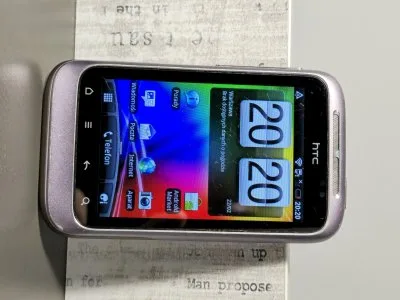
Photo: Beamish4 via Wikimedia Commons (CC BY-SA 4.0)
HTC Wildfire S
HTC Wildfire S price in: Sri Lanka · India · Pakistan · Bangladesh · Nepal · USA · Canada · UK · Australia · New Zealand · UAE · Saudi Arabia · Qatar · Kuwait · Singapore · Malaysia · Thailand · Indonesia · Philippines · Vietnam · Japan · South Korea · China · Hong Kong · Germany · France · Italy · Spain · Netherlands · Ireland · Portugal · Sweden · Norway · Denmark · Switzerland · Poland · Turkey · Russia · South Africa · Nigeria · Kenya · Egypt · Ghana · Brazil · Mexico · Argentina · Chile · Colombia
HTC Wildfire S Price
The HTC Wildfire S lowest price is $16, based on current retailer listings.
Full Specifications
Display
| Type | TFT capacitive touchscreen, 256K colors |
| Size | 3.2 inches |
| Resolution | 320 x 480 pixels, 180 ppi density |
Platform
| OS | Android 2.3 (Gingerbread), upgradable to 2.3.5, with HTC Sense UI 2.1 |
| Chipset | Qualcomm MSM7227 Snapdragon S1 |
| CPU | 600 MHz ARM 11 |
| GPU | Adreno 200 |
Memory
| Internal | 512MB ROM, 512MB RAM (418 MB user-available) |
| Card slot | microSDHC, up to 32GB (2GB included in some markets) |
Main Camera
| Single | 5 MP, autofocus, LED flash |
| Features | Geo-tagging |
| Video | 480p |
Selfie Camera
| Single | None |
Battery
| Type | Removable Li-Ion |
| Capacity | 1230 mAh |
| Talk time | Up to 5 hours 50 minutes |
| Stand-by | Up to 570 hours |
Body
| Dimensions | 101.3 x 59.4 x 12.4 mm (3.99 x 2.34 x 0.49 in) |
| Weight | 105 g (3.70 oz) |
| SIM | Mini-SIM |
Comms
| WLAN | Wi-Fi 802.11 b/g/n |
| Bluetooth | 3.0, A2DP, FTP/OPP, PBAP profiles |
| GPS | Yes, with A-GPS |
| Radio | Stereo FM radio with RDS |
| USB | microUSB 2.0 |
Launch
| Announced | February 2011 |
| Status | Released May 2011 |
Pros & Cons
Pros
- Compact and easy to handle
- Affordable price point at launch
- HTC Sense UI offered a user-friendly experience
- Decent camera for its class at the time
- Expandable storage
Cons
- Low screen resolution by modern standards
- Limited internal storage and RAM
- Older Android version (Android 2.3 Gingerbread)
- Modest processor performance
- No front-facing camera
In The Box & Warranty
- HTC Wildfire S handset
- 1230 mAh battery
- Wall charger
- USB cable
- Stereo headset
- User manual
Standard manufacturer's warranty applied at the time of purchase, typically one year.
Questions & Answers
What operating system does the HTC Wildfire S run?
The HTC Wildfire S originally ran on Android 2.3 Gingerbread, enhanced with HTC's Sense UI 2.1.
When was the HTC Wildfire S released?
The HTC Wildfire S was announced in February 2011 and released in May 2011.
Does the HTC Wildfire S have a front-facing camera?
No, the HTC Wildfire S does not feature a front-facing camera; it only has a single 5-megapixel camera on the rear.
Can I use modern apps on the HTC Wildfire S?
Due to its outdated Android 2.3 operating system and limited hardware, the HTC Wildfire S cannot run most modern applications available today.
What was the original price of the HTC Wildfire S?
At its launch, the HTC Wildfire S was often available for around $79.99 with a two-year contract and a mail-in rebate.
Is the HTC Wildfire S still a viable smartphone today?
No, the HTC Wildfire S is not considered a viable smartphone for daily use today due to its obsolete software, limited hardware, and lack of support for current network standards and applications.