
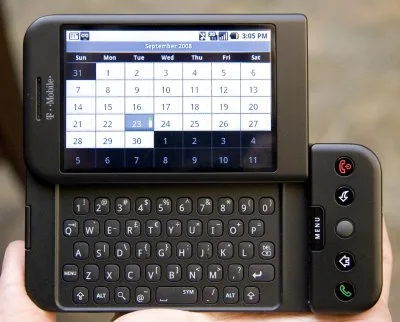
Photo: Michael Oryl via Wikimedia Commons (CC BY-SA 2.0)
HTC Dream (T-Mobile G1)
HTC Dream (T-Mobile G1) price in: Sri Lanka · India · Pakistan · Bangladesh · Nepal · USA · Canada · UK · Australia · New Zealand · UAE · Saudi Arabia · Qatar · Kuwait · Singapore · Malaysia · Thailand · Indonesia · Philippines · Vietnam · Japan · South Korea · China · Hong Kong · Germany · France · Italy · Spain · Netherlands · Ireland · Portugal · Sweden · Norway · Denmark · Switzerland · Poland · Turkey · Russia · South Africa · Nigeria · Kenya · Egypt · Ghana · Brazil · Mexico · Argentina · Chile · Colombia
HTC Dream (T-Mobile G1) Price
The HTC Dream (T-Mobile G1) lowest price is $90, based on current retailer listings.
Full Specifications
Display
| Type | TFT capacitive touchscreen, 65K colors |
| Size | 3.2 inches |
| Resolution | 320 x 480 pixels, HVGA (~180 ppi density) |
| Protection | Not specified |
Platform
| OS | Android 1.0 (upgradable to Android 1.6 Donut) |
| Chipset | Qualcomm MSM7201A |
| CPU | 528 MHz ARM 11 |
| GPU | Adreno 130 |
Memory
| Internal | 256 MB ROM, 192 MB RAM |
| Card slot | microSD, up to 16 GB (1GB card often included) |
Main Camera
| Single | 3.15 MP, autofocus |
| Features | Geo-tagging (requires microSD card for saving photos) |
| Video | No video recording at launch |
Selfie Camera
| Single | None |
Battery
| Type | Removable Li-Ion 1150 mAh battery |
| Talk time | Up to 5.8 h (3G) / 6.76 h (2G) |
| Stand-by | Up to 130 h |
Body
| Dimensions | 117.7 x 55.7 x 17.1 mm (4.63 x 2.19 x 0.67 in) |
| Weight | 158 g (5.6 oz) |
| SIM | Mini-SIM |
| Build | Plastic body with a slide-out QWERTY keyboard and a "chin" design. |
Comms
| WLAN | Wi-Fi 802.11b/g |
| Bluetooth | 2.0, A2DP |
| GPS | A-GPS |
| NFC | No |
| Radio | No |
| USB | ExtUSB (Mini-USB compatible) |
Launch
| Announced | September 2008 |
| Status | Discontinued |
Pros & Cons
Pros
- Pioneering Android operating system
- Physical QWERTY keyboard for efficient typing
- Integrated Google services
- Expandable storage via microSD
- User-replaceable battery
Cons
- Bulky and heavy design
- No 3.5mm headphone jack
- No video recording at launch
- Limited internal storage
- "Chin" design and keyboard trough were considered awkward by some
- Early Android OS had limitations compared to later versions
In The Box & Warranty
- HTC Dream (T-Mobile G1) Handset
- 1150 mAh Battery
- Mini-USB Sync Cable
- USB AC Adapter
- Stereo Headphones
- Manuals
Standard manufacturer's warranty at the time of purchase, typically one year.
Questions & Answers
What was the significance of the HTC Dream (T-Mobile G1)?
The HTC Dream, also known as the T-Mobile G1, holds historical significance as the first commercially released smartphone to run Google's Android operating system, marking the beginning of Android's dominance in the mobile market.
When was the HTC Dream (T-Mobile G1) released?
The HTC Dream (T-Mobile G1) was first released on October 20, 2008 through T-Mobile.
Did the HTC Dream (T-Mobile G1) have a physical keyboard?
Yes, the HTC Dream (T-Mobile G1) featured a distinctive slide-out QWERTY physical keyboard, which was a popular input method at the time of its release.
What operating system did the HTC Dream (T-Mobile G1) run?
The HTC Dream (T-Mobile G1) launched with Android 1.0, making it the inaugural device for the Android operating system, and was later upgradable to Android 1.6 Donut.
Can the HTC Dream (T-Mobile G1) still be used today?
While technically functional, the HTC Dream (T-Mobile G1) is largely obsolete for modern use due to its outdated operating system, limited app support, and compatibility issues with current network technologies. It is primarily a collector's item.
Did the HTC Dream (T-Mobile G1) have a headphone jack?
No, the HTC Dream (T-Mobile G1) did not feature a standard 3.5mm headphone jack; instead, it utilized a proprietary ExtUSB port for audio output.