
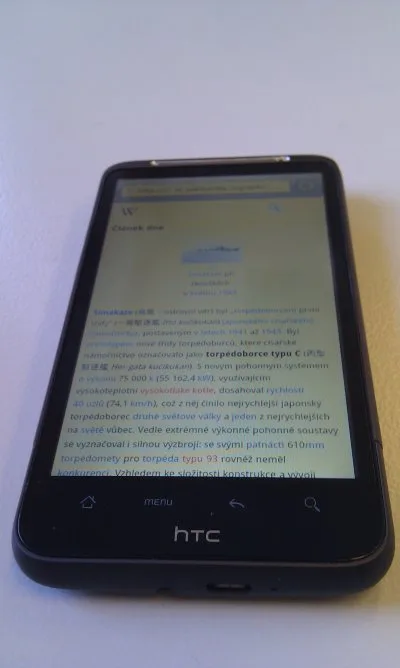
Photo: El Carlos via Wikimedia Commons (CC BY-SA 3.0)
HTC Desire
HTC Desire price in: Sri Lanka · India · Pakistan · Bangladesh · Nepal · USA · Canada · UK · Australia · New Zealand · UAE · Saudi Arabia · Qatar · Kuwait · Singapore · Malaysia · Thailand · Indonesia · Philippines · Vietnam · Japan · South Korea · China · Hong Kong · Germany · France · Italy · Spain · Netherlands · Ireland · Portugal · Sweden · Norway · Denmark · Switzerland · Poland · Turkey · Russia · South Africa · Nigeria · Kenya · Egypt · Ghana · Brazil · Mexico · Argentina · Chile · Colombia
HTC Desire Price
The HTC Desire lowest price is $174, based on current retailer listings.
Full Specifications
Display
| Type | AMOLED or SLCD capacitive touchscreen, 16M colors |
| Size | 3.7 inches, 39.0 cm2 (~54.6% screen-to-body ratio) |
| Resolution | 480 x 800 pixels, 5:3 ratio (~252 ppi density) |
| Protection | Corning Gorilla Glass |
Platform
| OS | Android 2.1 (Eclair), upgradable to 2.2 (Froyo) and officially to 2.3 (Gingerbread via manual flash) |
| Chipset | Qualcomm QSD8250 Snapdragon S1 |
| CPU | 1.0 GHz Scorpion (single-core) |
| GPU | Adreno 200 |
Memory
| Card slot | microSDHC (dedicated slot), up to 32 GB (4 GB included) |
| Internal | 576 MB RAM, 512 MB ROM (150 MB user accessible flash storage) |
Main Camera
| Single | 5 MP, autofocus |
| Features | LED flash, geotagging |
| Video | 480p@15fps, 720p@30fps (via software update) |
Selfie Camera
| Single | No |
Battery
| Type | Removable Li-Ion 1400 mAh battery |
| Stand-by | Up to 340 h (2G) / Up to 360 h (3G) |
| Talk time | Up to 6 h 40 min (2G) / Up to 6 h 30 min (3G) |
Body
| Dimensions | 119 x 60 x 11.9 mm (4.69 x 2.36 x 0.47 in) |
| Weight | 135 g (4.76 oz) |
| SIM | Mini-SIM |
| Other | Optical trackpad |
Comms
| WLAN | Wi-Fi 802.11 b/g, hotspot (Android 2.2) |
| Bluetooth | 2.1, A2DP |
| Positioning | GPS, A-GPS |
| Radio | Stereo FM radio with RDS |
| USB | microUSB 2.0 |
Launch
| Announced | 2010, February 16 |
| Status | Released 2010, March/April |
Pros & Cons
Pros
- Gorgeous and vibrant AMOLED screen (for early models)
- Fast 1 GHz Snapdragon processor for its time
- Excellent web browser with Flash support
- HTC Sense UI provided a refined Android experience
- Solid build quality
Cons
- Battery life could be disappointing and required daily recharging
- 5 MP camera was considered average, especially for video quality
- Limited internal storage for apps
- Later models switched to SLCD due to AMOLED shortages
- Bluetooth playback could stutter
In The Box & Warranty
- HTC Desire Handset
- 1400 mAh Battery
- microUSB Cable
- Wall Charger
- Stereo Headset
- User Manual
New phones typically came with a standard one-year manufacturer's warranty.
Questions & Answers
What is the HTC Desire?
The HTC Desire is an iconic Android smartphone released by HTC in 2010, known for being one of the first devices to feature Android 2.1 Eclair with the HTC Sense user interface and a 1 GHz Snapdragon processor.
When was the original HTC Desire released?
The original HTC Desire was announced on February 16, 2010, and began shipping in various regions, in March and April 2010.
What operating system did the HTC Desire run?
It launched with Android 2.1 Eclair and was officially upgradable to Android 2.2 Froyo. A developer-oriented update to Android 2.3 Gingerbread was also made available.
Does the HTC Desire have a good camera?
The HTC Desire featured a 5 MP autofocus camera with an LED flash. While considered decent for its time, its video recording capabilities (480p@15fps, later 720p@30fps via update) and overall image quality were often described as average compared to competitors.
What was unique about the HTC Desire's display?
Early versions of the HTC Desire featured a vibrant 3.7-inch AMOLED display. However, due to supply shortages, later production runs switched to an S-LCD panel, which offered different characteristics in terms of color reproduction and contrast.
Is the HTC Desire still usable today?
While functional, the HTC Desire is largely obsolete for modern daily use. Its outdated Android version limits app compatibility, and its hardware cannot handle current smartphone demands. It is primarily suitable for collectors or as a historical tech artifact.